
Besuch aus Italien am IPN: Im Gespräch mit Kristin Litteck und Matteo Lavecchia
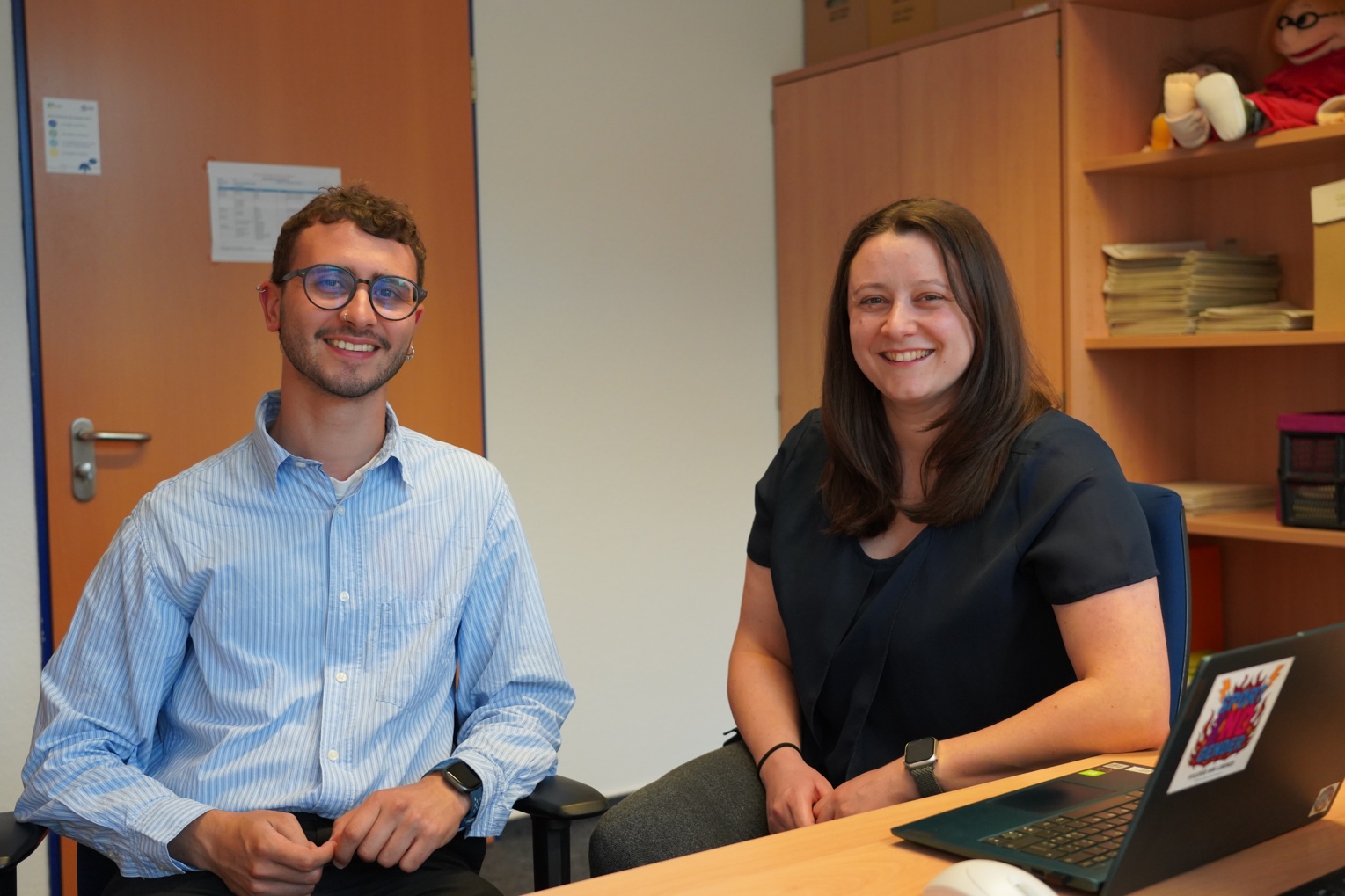
Internationale Zusammenarbeit spielt auch in der Mathematikdidaktik eine wichtige Rolle: In den vergangenen Monaten war Matteo Lavecchia, Masterstudent an der Sapienza Università di Roma, zu Gast in der Abteilung Didaktik der Mathematik am IPN. Gemeinsam mit Dr. Kristin Litteck arbeitete er an einer deutsch-italienischen Studie zum Wissen von Schüler*innen über den Ableitungsbegriff.
Im Rahmen seiner Masterarbeit hat Matteo Lavecchia eine zentrale Studie aus der Dissertation von Dr. Litteck im italienischen Kontext repliziert. Dafür wurden ein Vorwissenstest sowie ein Test zum Wissen über den Ableitungsbegriff ins Italienische übersetzt und analog zur ursprünglichen Untersuchung eingesetzt. Während seines Aufenthalts am IPN lag der Schwerpunkt auf der Codierung und Auswertung der erhobenen Daten.
Die Studie ist Teil einer größeren Forschungskooperation, in der untersucht wird, wie Schüler*innen mathematische Konzepte erwerben und welche Rolle dabei ihr Vorwissen spielt. Die Ergebnisse aus Italien sollen dabei auch mit bisherigen Befunden aus Deutschland und der laufenden Forschung mit Partnern in Taiwan verglichen werden. So wollen die Forschenden unter anderem untersuchen, inwieweit sich das zugrunde liegende Wissensmodell auf unterschiedliche Länder und Bildungstraditionen übertragen lässt.
Wir haben die Gelegenheit genutzt und mit Matteo Lavecchia und Dr. Kristin Litteck über die deutsch-italienische Zusammenarbeit, die Replikationsstudie und erste Einblicke in ihre Forschung gesprochen (Interview auf Englisch):
IPN: Welcome to Kiel and the IPN! Matteo, how has your stay in Germany been so far, and what motivated you to come to Kiel for your master’s thesis?
Matteo Lavecchia: Moin, and thank you for the warm welcome! My stay in Germany so far has been incredibly enriching in many different ways. The places I have had the chance to explore, from Kiel and Lübeck to Sylt, Hamburg, and Bremen, have allowed me to experience some truly remarkable natural landscapes. What has particularly struck me is the sense that nature is regarded as something that belongs to everyone and that everyone, in turn, feels responsible for protecting and taking care of it. At the same time, my experience at the IPN has been equally rewarding from an academic and personal perspective. I have had the opportunity to meet people who are not only extremely knowledgeable and highly competent in their fields, but also genuinely welcoming and kind. Being surrounded by this environment allows me to learn something new every day and to grow both as a researcher and as a person.
These are also some of the main reasons why I chose Kiel for my master’s thesis. I was particularly interested in learning more about quantitative methods in mathematics education research, and while looking for an institution where I could develop these skills, I came across the IPN. The more I learned about its work and its contribution to mathematics education, the more interested I became. I then explored Professor Aiso Heinze’s research in greater depth and found his work particularly fascinating, which ultimately encouraged me to contact him. And, of course, I have always been fascinated by Northern Europe, so the opportunity to combine this personal interest with such a valuable academic experience made Kiel an opportunity I simply could not pass up.
IPN: Dr. Litteck, how did the collaboration with Matteo come about, and how did the idea for this German–Italian study develop?
Kristin Litteck: The collaboration developed somewhat organically from Matteo’s initial interest in completing his master’s thesis at the IPN. When we first started discussing possible topics, his interests were initially connected to comparing educational research and data from Germany and Italy. In our conversations, however, we realized that there was an even stronger connection with one of our main research areas here at the IPN: students’ understanding of the concept of derivative and the role of prior knowledge in developing this understanding.
I therefore suggested this topic to Matteo as a possible focus for his master’s thesis. What made the idea particularly interesting was that it also offered the opportunity to extend the research to the Italian context and collect data there. This was particularly interesting in light of the ongoing revision of the national curriculum for licei. With the support of Professor Annalisa Cusi as the supervisor of Matteo’s thesis and the University of Rome, Matteo was able to pursue the topic in the Italian educational context while being part of the research environment at the IPN. This was a very nice starting point for combining our different perspectives and experiences.
What initially started as a request from a student looking for a place to complete his master’s thesis therefore gradually developed into a genuine German–Italian research collaboration. I think that is one of the particularly rewarding aspects of the project: we are not simply transferring an existing study from one context to another, but are using the collaboration to learn more about how students’ mathematical understanding develops across different educational contexts.
IPN: Your joint project focuses on students’ prior knowledge and their understanding of the concept of derivative. Why is this topic particularly important for research in mathematics education?
Matteo Lavecchia: The derivative is a particularly interesting concept for mathematics education research because of the central role it plays both within mathematics and in many other fields. It provides a mathematical way of describing change and is therefore essential for understanding phenomena involving quantities such as velocity, temperature, population, or prices. At the same time, it is a fundamental concept in mathematical analysis and an important prerequisite in many STEM and non-STEM university programs. Despite this relevance, research has repeatedly shown that students often struggle to develop a meaningful understanding of what the derivative actually represents, even when they are able to perform standard calculations.
This is where prior knowledge becomes particularly important. The derivative is usually one of the last major mathematical concepts introduced in secondary school, and its understanding builds on knowledge that students have developed over several years. From both a theoretical and an educational perspective, it is therefore interesting to investigate which of these previous knowledge domains are particularly important for developing an understanding of the derivative. Studying this relationship can help us better understand why some students find the transition to calculus more difficult than others. More importantly, it may help identify what can already be strengthened before the derivative is formally introduced, so that students have a stronger foundation on which to build their understanding of the concept.
Kristin Litteck: From our perspective, one particularly interesting aspect is that prior knowledge is not a single, homogeneous construct. In our research, we therefore distinguish between different areas of mathematical prior knowledge, such as knowledge about functions, slopes and rates of change, limits, and algebraic manipulation. This allows us to investigate more specifically which aspects of students’ previous knowledge are particularly important for developing a conceptual understanding of the derivative. In the long term, this may also provide valuable insights into how students can be better prepared for learning calculus before the derivative is formally introduced.
IPN: Matteo, your master’s thesis replicates a study from Kristin Litteck’s doctoral research in the Italian context. What does it mean to replicate a study in another country, and what do you hope to learn from this comparison?
Matteo Lavecchia: Replicating a study in another country means extending the same research design to a different educational context while keeping as many aspects of the study as comparable as possible. In our case, this required particular attention to the translation and adaptation of the tests, so that language itself would not become a source of bias. It also meant selecting the schools carefully, administering the tests under comparable conditions and within similar time frames, and following the same procedures for coding, scoring, and analyzing students’ responses.
At the same time, there is one difference that cannot—and should not—be removed: the students belong to different countries and educational systems. For me, this is precisely what makes a cross-country replication particularly interesting. By keeping the research design as consistent as possible, we can investigate whether the patterns observed in Germany also emerge in the Italian context and, at the same time, identify possible differences between the two samples.
What I hope to learn from this comparison is therefore not simply whether the results are the same or different, but what these similarities and differences may tell us about the two educational contexts. In particular, they may help us reflect on how different curricular and teaching traditions are related to the knowledge students develop before encountering the derivative and to their subsequent understanding of the concept. For example, derivatives are typically introduced earlier in the German curriculum, around grades 10 or 11, whereas in Italy they are generally introduced in the final year of upper secondary school, corresponding to grade 13. In this way, the comparison can also provide useful insights into which aspects of students’ prior knowledge might deserve greater attention in teaching.
Kristin Litteck: From our perspective, the comparison is particularly interesting because the German and Italian educational contexts differ in several respects, including curricula and students’ prior mathematical knowledge. This gives us the opportunity to examine whether the relationships between students’ prior knowledge and their understanding of the derivative that we observed in Germany can also be found in Italy. At the same time, potential differences between the two contexts may provide insights into how different educational experiences shape students’ mathematical understanding.
For us, this makes the Italian data more than simply an additional sample: they allow us to better understand which aspects of our findings may be more general and which may be related to the specific educational context.
IPN: You are currently working on coding and analyzing the data. Are there already any first impressions or observations that you find particularly interesting?
Matteo Lavecchia: One of the most interesting first impressions concerns the comparison between the two countries. When looking at students’ ability levels in the Derivative Test, the overall distributions in the Italian and German samples appear qualitatively quite similar. I found this particularly interesting because, despite the differences between the two educational contexts, students seem to show a rather similar overall pattern in their understanding of the derivative.
At the same time, the picture becomes more differentiated when we look at the individual domains of prior knowledge. In particular, we observe a noticeable difference between the two samples in the subtest concerning fractions and algebraic manipulations. This contrast is especially interesting precisely because it appears alongside the relatively similar distributions in derivative knowledge. For me, this raises two important questions. The first is what might explain this difference in prior knowledge and whether it can be related to differences in curricula or teaching traditions between the two countries.
The second, which is even more closely connected to the main focus of my thesis, is whether and to what extent this difference is reflected in students’ understanding of the derivative. Of course, these are still preliminary observations, so I would be cautious about drawing conclusions at this stage. But I think this combination of similarities in derivative knowledge and differences in specific areas of prior knowledge provides a particularly interesting starting point for the analysis.
IPN: What are the next steps for the project, and are there plans for further collaboration or joint publications?
Kristin Litteck: The next step is to complete analysis of the data and to compare the findings from Italy with those from Germany. We are particularly interested in seeing which patterns are similar across the two contexts and where we might find interesting differences. Once the analyses are complete, we hope to develop the results into a joint publication.
For me, one of the most exciting aspects of the project is that the collaboration does not necessarily have to end with Matteo’s master’s thesis. We have already established a very productive connection between the IPN and the University of Rome, and I would be very happy if this could lead to further joint research in the future.
On a personal level, I also hope that Matteo takes some good memories from his time in Kiel with him. He has not only contributed to our research, but has also become part of our everyday life at the IPN. And I think experiencing Kiel in summer – including the Kieler Woche - is a pretty good way to discover that Northern Germany has its own advantages compared to Rome, even if the weather does not always cooperate!