

Farewell from the IPN: Prof. Dr. Hans Anand Pant retires
At the end of September 2026, concluding a four-year tenure, Prof. Dr. Hans Anand Pant retired from his position as head of the IPN’s Department of Subject-Related Knowledge Transfer.
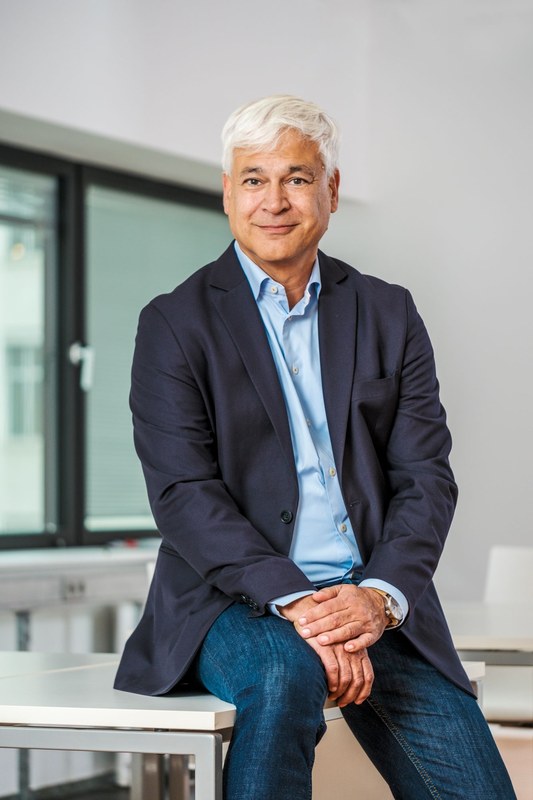
“Some say that we in the education sector don’t have a problem with knowledge, but a problem with its transfer. I would counter this proposition with the reply that we do have a problem with knowledge – the knowledge of how to make transfer effective.” This is the assertion with which, back in 2022, Prof. Dr. Hans Anand Pant took up his position as head of the IPN’s Department of Subject-Related Knowledge Transfer. Fast forward four years, and the IPN can look back on a period during which the transfer of academic findings into educational practice has significantly intensified and has now established itself in a central role in the field.
“Hans Anand Pant’s retirement from the IPN sees us saying a reluctant farewell to a researcher whose commitment to operationalizing academic discoveries for the day-to-day work of education has been outstanding. We would like to extend our grateful thanks to him for his energy and enthusiasm and for the inspirational directions he has set at the IPN over the last four years,” said Prof. Dr. Olaf Köller, the IPN’s Managing Director of Research.
During his time heading up our Department of Subject-Related Knowledge Transfer, Prof. Pant focused primarily on the issue of how we can feed academic and scientific findings into educational practice in a way that enables them to have long-term real-world impact. Among his key research interests at the IPN were knowledge transfer and implementation and the use of data to support school development and drive improvements in teaching.
QuaMath: linking education research and classroom practice
One of the defining projects of Prof. Pant’s tenure was the initial stage of the Germany-wide QuaMath program, which aims to develop the quality of teaching and CPD in the subject of mathematics. As a member of the team leading on the program’s academic side, Prof. Pant was key to the process of drawing up and realizing this ten-year program, which commenced in 2023 and receives funding from Germany’s Standing Conference of the Ministers of Education, Science and Cultural Affairs. The IPN and the German Centre for Mathematics Teacher Education (DZLM) act as the program’s coordinating institutions.
QuaMath’s objective is to make long-term improvements in the quality of math teaching in Germany by creating and testing teaching and CPD resources informed by academic and scientific findings and designed for the needs of practitioners and by gathering data to serve as a basis for their ongoing development. A total of 550 teachers are currently receiving training to enable them to support teams of teachers, organized in networks of schools, in using the resources.
At the time of writing, over 3,000 schools and almost 11,000 teachers are involved in the project, forming the first three of a planned total of eight annual school cohorts. Going forward, we hope to engage up to 10,000 schools, amounting to around a third of Germany’s schools delivering general education; this ambition will make QuaMath the largest program of its kind in Germany. The project provides an exemplary demonstration of the approach that Prof. Pant set out when he joined the IPN: that it’s not only what academic study has found out that matters, but also the conditions needed to transfer academic findings to the real world so that they can unfold an impact on a broad scale. In his work on the program, Prof. Pant placed particular emphasis on engaging senior school leadership teams and taking the requirements of supervisory education authorities into account.
Knowledge transfer: beyond math
Alongside his work on QuaMath, Prof. Pant was involved in a range of projects at the IPN, centering on creating closer ties between academia and the classroom. As part of the knowledge transfer team of the lernen:digital consortium, he helped intensify systematic dialog between education research and classroom practice, taking on a role at the intersection of academia, institutions of the German federal states, and other actors in the education landscape.
Alongside Prof. Dr. Moritz Krell, Prof. Pant led on a project titled DE²nga – Digitally-supported scientific reasoning meets service learning, which aims to create, test, and evaluate CPD for teachers around digitally-supported scientific reasoning in the biology classroom. Part of its strategy entails training teachers to pass on and establish research findings in the day-to-day work of schools.
Both of these activities exemplify the ethos of knowledge transfer which Prof. Pant brought to his work at the IPN, and which holds that successful long-term transfer takes place when it focuses, not simply on communicating scientific findings to others, but also on working alongside practitioners in the field to explore the conditions, possibilities, and limits of academic knowledge and drive its advancement.
Looking back on his time at the IPN, Prof. Pant said: “The IPN’s involvement in the major Germany-wide QuaMath and Startchancen Mathematics Competency Center projects, working in partnership with the DZLM, represents the foundations of close, continuous collaboration across federal state borders, working with senior figures in state education authorities to bring about qualitative, systemic and broad-based change in Germany’s teacher CPD landscape with the ultimate aim of improving the quality of teaching and student performance in math.”
Over the last four years, Prof. Pant’s work with us has materially advanced subject-related knowledge transfer at the IPN and therefore our research in general. We said farewell to him at the end of September 2026. As he embarks on his retirement, we would like to thank him for all our work together, his expertise, and the inspiration he has provided for subject-related knowledge transfer at the Institute, and wish him all the best for this next stage in his life.


