
Quod erat demonstrandum
Can mathematical understanding of proof be systematically fostered?
by Femke Sporn
A theoretical framework for learners' understanding of mathematical proofs was developed at the IPN to answer the question of whether understanding of mathematical proofs can be fostered in a targeted manner. The framework was used to investigate learners' understanding of proof before and after an intervention.
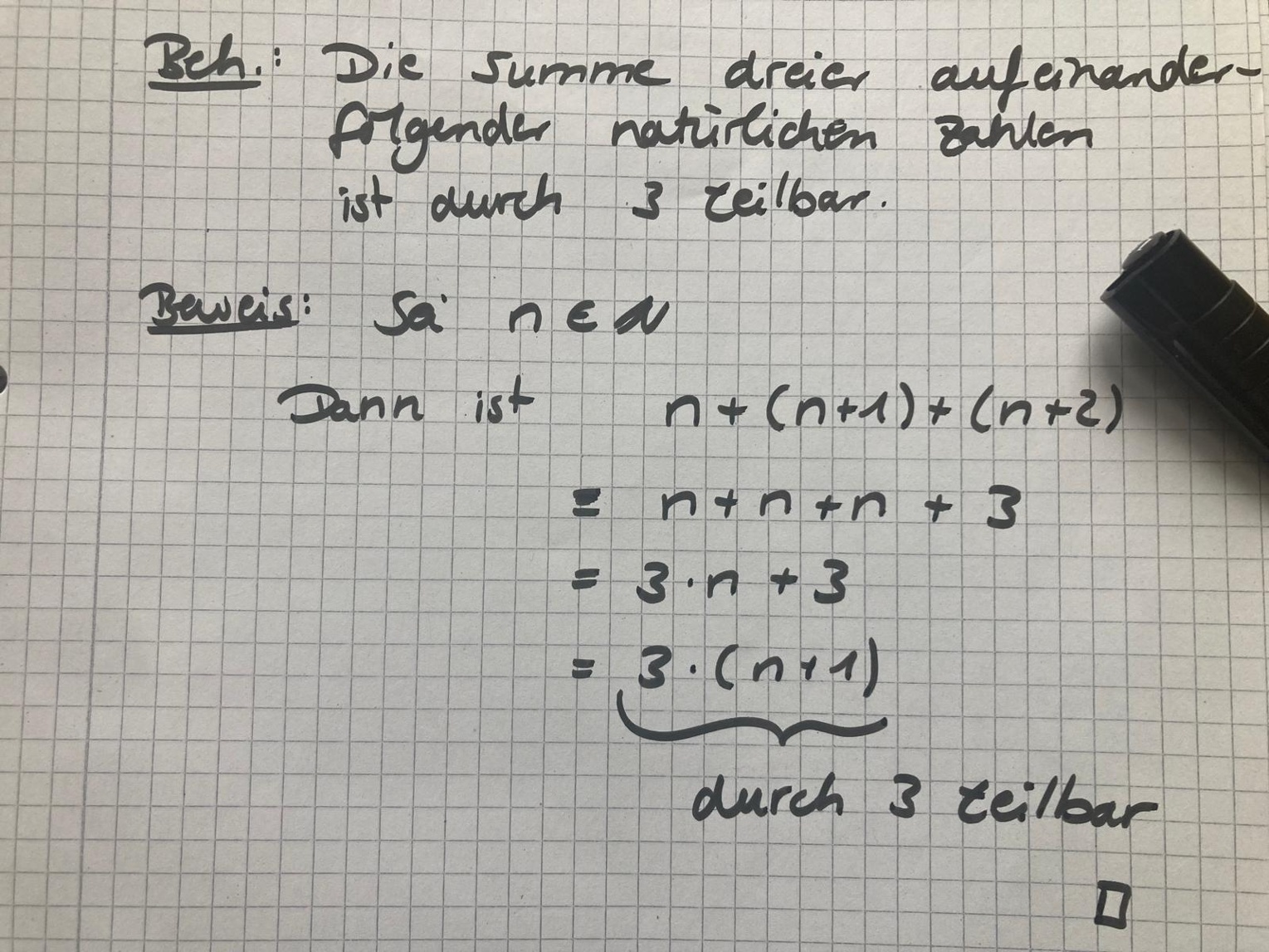
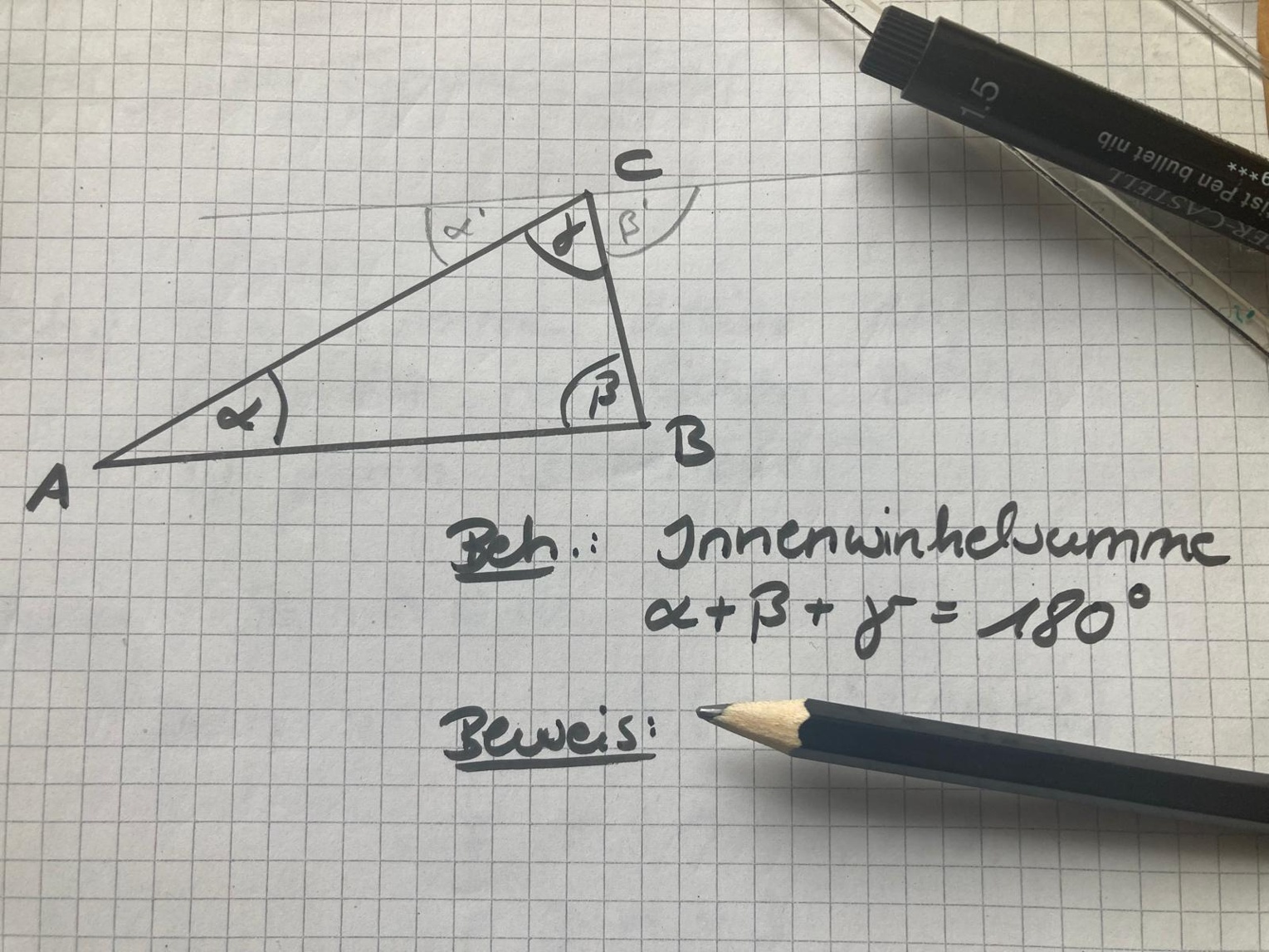

Mathematical proof is the method used to generate evidence in mathematics. Mathematical proofs are used to substantiate statements and rules in mathematics and to gain new insights. Hence, mathematical proofs are taught in secondary school mathematics classes, and are already introduced in a simplified form in elementary school as part of mathematical reasoning. Mathematics lessons without any mention of proof would be comparable to chemistry or physics lessons without experiments – an essential aspect of the subject would be missing. Alongside the acquisition of certain mathematical skills, it is therefore important that learners become familiar with mathematics as a discipline of proof.
In the course of their schooling, students repeatedly deal with mathematical proofs. In Germany, this happens primarily from the seventh grade onwards in geometry classes (e.g., using the interior angle sum theorem or the Pythagorean theorem).
Developing a framework for understanding of proof
As learners repeatedly engage with mathematical proofs, they should build up an understanding of proof, and it is likely that this understanding will develop over time. An understanding of proof means that learners understand the concept of proofs, their functions, rules, and principles, and their significance for mathematics. Such an understanding of proof is comparable to an understanding of the role of experimentation in chemistry or physics.
However, a review of previous research shows that there is no uniform definition of this understanding of proof. As a result, neither learners' understanding of proof nor its development has been systematically investigated to date. A theoretical framework for understanding of proof was first developed to close this research gap, integrating various aspects and distinctions from previous research. This framework allows the findings of previous research to be systematized and creates a uniform basis for future research. Central distinctions in the framework include, for example, the subject-specific perspective on proofs and the individual understanding of proof, as well as the concept- and action-oriented focus of the individual understanding of proof.
Understanding of proof throughout mathematical education

The theoretical framework made it possible to measure learners' understanding of proof, i.e., a large number of tasks and questions were developed to capture the various aspects of understanding of proof. Two empirical studies investigating learners' understanding of proof were conducted on this basis: a cross-sectional study with first-year mathematics students (Study 1) and a quasi-longitudinal study with school students (Study 2).
The results show that students' understanding of proof is poorly developed and, contrary to expectations, hardly improves during their school career. Students in grades 8 to 11 had difficulty specifying criteria for valid proofs. For example, around 85% of students did not recognize that five specific examples are not sufficient to prove the statement “The sum of three consecutive natural numbers is divisible by 3” as universally valid. First-year university students also had difficulties, although they demonstrated a slightly higher level of understanding of proof than the students. However, since mathematics students are a positively selected group, this result must be viewed in context.
Overall, both studies suggest that learners' understanding of proof barely develops positively during their school years – even though they regularly deal with mathematical proofs in mathematics lessons. While the studies do not provide detailed information on the learning opportunities available to learners, the results suggest that the current learning opportunities are insufficient.
Specific fostering of understanding of proof
Given the rather low level of understanding of proof, the question arose as to whether specific fostering was possible. As part of a quasi-experimental intervention study (Study 3), a learning environment was developed that offers a wide range of learning opportunities for mathematical proof for ninth-grade students. The intervention consists of five lessons that can be integrated into regular mathematics classes over the course of a school semester. The learning opportunities developed tie in with content that is already planned for mathematics lessons, with a particular focus on reflection and discussion about proofs. For example, students are asked to use unacceptable attempts at proof to work out that an argument based on statements that have not yet been proven cannot constitute a valid mathematical proof. Criteria for proofs are also explicitly formulated and displayed on a poster throughout the entire intervention.
The study examined students' understanding of proof before and after the intervention and compared it with the understanding of a control group that did not participate in the intervention. The results show that the learning opportunities developed were able to strengthen at least some aspects of understanding of proof. For example, the students improved in validating incorrect purported proofs. However, even after the intervention, their understanding of proof remains below the level that would be desirable from a technical point of view.
Conclusion
The studies presented here provide insight into learners' understanding of proof and its development over the course of their mathematics education. The results of the first two studies suggest that targeted support for understanding of proof should also be integrated into other grade levels. Based on these results, further teaching materials are now to be developed and tested for use in seventh grade and above in order to investigate whether regular, targeted support for understanding of proof can lead to long-term improvements.
About the author:

Dr. Femke Sporn is a Postdoctoral researcher in the Department of Mathematics Education at the IPN. She studied mathematics and biology at Kiel University with the aim of becoming a school teacher. These findings are based on parts of her dissertation, which she wrote at the IPN.
Further literature:
Sporn, F., Sommerhoff, D., & Heinze, A. (2021). Beginning university mathematics students' proof understanding. In M. Inprasitha, N. Changsri, & N. Boonsena (Hrsg.), Proceedings of the 44th Conference of the International Group for the Psychology of Mathematics Education (S. 105-112). PME.
Sporn, F., Sommerhoff, D., & Heinze, A. (2022). Students' Knowledge About Proof and Handling Proof. In C. Fernández, S. Llinares, Á. Gutiérrez, & N. Planas (Hrsg.), Proceedings of the 45th Conference of the International Group for the Psychology of Mathematics Education (S.27-34), PME.
Sporn, F., Sommerhoff, D., & Heinze, A. (2023). Fostering students' knowledge about proof. In M. Ayalon, B. Koichu, R. Leikin, L. Rubel, & M. Tabach (Hrsg.), Proceedings of the 46th Conference of the International Group for the Psychology of Mathematics Education (S. 235-242). PME.